
Monitoring Created Visibility. The Next Category Creates Evidence.
The evidence that made your system acceptable at deployment is not keeping pace with how that system behaves in the field.

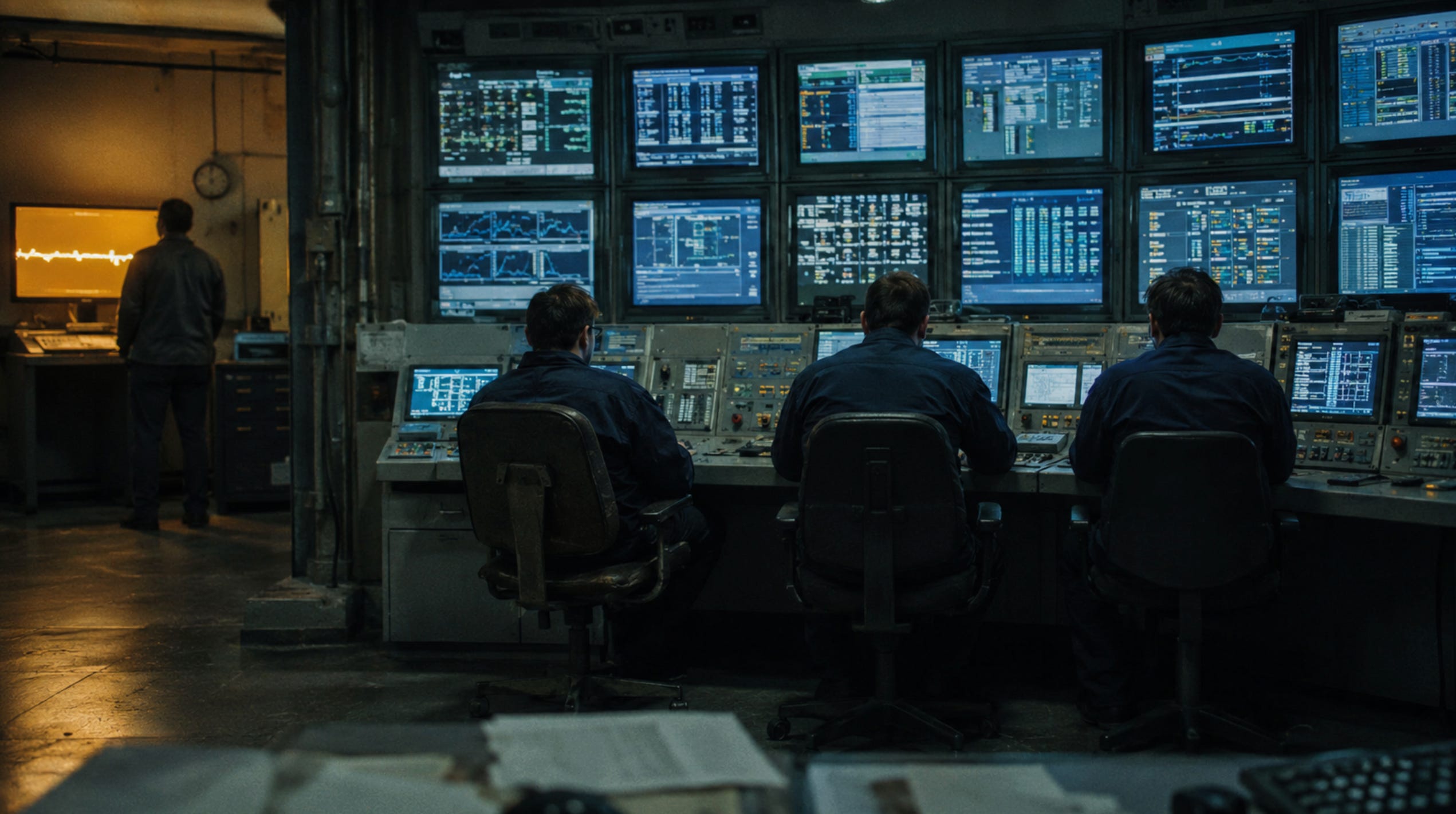
Industrial operations have a control gap: the evidence that made a system acceptable at deployment often does not keep pace with how that system behaves in the field.
The platform category built over the last two decades was designed to make that gap visible. Dashboards, alerts, telemetry pipelines, and audit logs were all oriented toward observation: what the system did, when it did it, and in what state.
The next category is built to close that gap, with the record serving the loop instead of replacing it.
What Monitoring Solved, and What It Did Not
The first wave of industrial monitoring was a genuine engineering achievement. Before ubiquitous connectivity, before cheap sensors, before cloud infrastructure, getting real-time signal out of distributed assets and into a place where humans could interpret it required real work. The platforms that solved that problem created real value.
They were built for a specific job: collect operational data, store it, display it, alert on thresholds. The implicit assumption was that a human would be at the end of the chain. A person would read the dashboard. A person would triage the alert. A person would decide what to do.
That assumption was reasonable when systems changed slowly, update cycles were measured in years, and operators could absorb the signal volume. It becomes fragile when assets are software-defined, continuously updated, and operating across long-tail conditions no test environment fully anticipated.
The platforms that built the monitoring category are not wrong. They are optimized for the problem they were designed to solve. The problem has changed faster than the category has.
Why Software-Defined Assets Break the Old Model
A modern vehicle, production machine, or distributed energy asset is not a mechanical object with a few sensors attached. It is a software-defined system. It receives updates over the air. Its behavior is shaped by software, configuration, control logic, and in some cases models trained on data that may not match the deployment environment.
When that system was commissioned, approved, or certified, someone documented what it was designed to do. They defined the objectives, drew the performance boundaries, established the success criteria, and recorded the assumptions that had to hold true for the system to behave as intended. That documentation is the basis for certification, underwriting, and operational approval.
Then the system goes into the field.
Real-world performance diverges from modeled performance. Users interact with the system in ways the design team did not anticipate. Environmental conditions vary outside the tested envelope. Software updates change behavior in ways that were not fully validated against each specific deployment context.
None of this is unusual. It is the normal operating condition of any system deployed at scale.
The problem is that the evidence package supporting the original approval often does not evolve at the same cadence as the system itself. The document that justified deployment on day one still reflects day-one assumptions on day four hundred. The operational state of the system has moved. The evidence base around it has not.
This is not a monitoring problem. You can add sensors and the gap does not close. You can build a better dashboard and the gap does not close. Visibility does not close it. The gap is in the relationship between what the system was approved to do and what it is doing right now, and whether anyone is continuously evaluating that relationship and enforcing a response when it breaks down.
The Difference Between Observability and Assurance
Monitoring platforms are built around an event log. Something happens; the system records it. The richer the telemetry, the more complete the record. Alert when a threshold is crossed. Report what occurred. That is a coherent architecture for its purpose.
The problem is that the core object is a record of past state. Even real-time alerts are notifications that a condition already exists. The system has already drifted, already triggered the threshold, already entered the state you were trying to prevent. The alert tells you something went wrong. It routes the problem to a queue.
In large asset bases, the constraint is rarely whether an alert was generated. It is whether the alert was evaluated, prioritized, and acted on inside the window where action could still change the outcome. At scale, the queue is not just a process failure. It is a design artifact.
Runtime assurance is built around a different core object: the live relationship between approved engineering intent and current operational behavior. The job is not to record what happened. It is to continuously evaluate whether the system remains inside the assumptions that made it safe, compliant, and insurable, and to enforce a bounded response when it does not.
The distinction the market needs is not dashboards versus runtime assurance. Dashboards can be part of an assurance architecture. The relevant contrast is passive observability versus enforceable assurance. Incumbents record operational state. Some detect anomalies. Some trigger workflows. The harder capability is maintaining a live, machine-evaluable representation of approved engineering intent and continuously reconciling deployed behavior against it. Even fewer can enforce bounded responses at the edge and preserve a continuous assurance record.
That is the category distinction.
What the Baseline Actually Means
The baseline is the central artifact, and it is worth being specific about what it contains.
It is not a static threshold. It is the engineering intent of the system expressed in a form that can be evaluated continuously against real operational data. That includes the performance envelope the system was designed to operate within. The behavioral assumptions validated at certification. The success criteria the engineers defined before deployment. The software version and configuration state at approval. The hazard analysis artifacts that defined the boundaries of acceptable operation. The operational design domain, where that concept applies.
When operational reality diverges from that baseline, the gap is measurable. It is not a gut feeling from an experienced technician. It is a quantifiable distance between where the system is and where it was approved to be.
That measurement is what makes bounded enforcement possible. The response to a deviation can be automated where the safe action is well-defined: a configuration rollback, a software version revert, a flag to a safety-rated control layer that something outside the approved envelope is occurring, a subsystem isolation, or a safe-state transition.
The assurance platform is not a replacement for functional safety architecture. It is a supervisor that operates above the control layer, continuously evaluating whether the system’s operational state remains within the assumptions that safety-rated systems were designed around. Where human authorization is required, the deviation is escalated with full context rather than dropped into an undifferentiated alert queue. The point is that evaluation and routing happen by design, within a defined trust boundary, not as a bypass of safety protocols.
This is not a novel idea in control systems engineering. The novelty is applying it systematically to the problem of software-defined operational compliance across distributed, continuously updated, heterogeneous asset fleets. That problem did not exist at scale when the monitoring category was built.
Why Incumbents Struggle to Add This
Parts of a runtime assurance capability can be bolted onto existing platforms. Incumbents can add anomaly detection, rules engines, edge agents, workflow automation, and audit logs. Some are doing exactly that.
The harder claim is that reporting-first architectures struggle to become assurance-first architectures because the semantic role of data is different. A reporting platform treats operational data as telemetry: strings and integers to be stored, aggregated, and surfaced. An assurance platform treats operational data as evidence against a contract. The same sensor reading that a monitoring platform logs as an event, an assurance platform evaluates against an approved baseline and routes to a defined response. You can extend a monitoring platform’s data model to include baseline schemas. What you cannot easily retrofit is the chain of custody. The unbroken, auditable record connecting approved engineering intent to every subsequent operational state and every response taken when the two diverged. That record is the product. Everything else is infrastructure around it.
Adding enforcement to a reporting platform is not impossible. It is a retrofit onto architecture that was not designed for it. The resulting product tends to be a reporting platform with attached workflow automation, which is useful, but is not the same as a platform designed from the ground up to close the loop between engineering intent and deployed behavior.
The question a sophisticated buyer should ask any incumbent is: where does the approved engineering baseline live in your data model? How does it update when the system does? How is the relationship between that baseline and current operational state evaluated, and by what mechanism is a bounded response enforced? The answers reveal whether the product is observability plus alerting or runtime assurance in the structural sense.
The Regulatory Direction
The regulatory environment has not yet required continuous operational assurance across most sectors. That is changing, unevenly but visibly.
The EU AI Act requires post-market monitoring for high-risk AI systems, including active and systematic collection, documentation, and analysis of relevant performance data throughout the system’s lifetime to evaluate continuous compliance. The obligation is not one-time certification. It is a continuous evidence obligation tied to deployed behavior.
UNECE WP.29 regulations require vehicle manufacturers to implement a Software Update Management System covering software update governance, OTA update controls, software identification, documentation, and safe update processes across vehicles in service. The regulatory frame is no longer limited to the vehicle at type approval. It increasingly extends to how software changes are governed across the vehicle’s life.
FDA guidance for AI-enabled device software functions points in the same direction through predetermined change control plans that describe planned modifications and the methodology for developing, validating, and implementing them. The framing is prospective governance of change, not just documentation after the fact.
None of these frameworks uses the phrase “runtime assurance platform.” But they all create the same underlying requirement: continuous evidence that a changing system remains inside the assumptions that made it acceptable. The value of a platform built to produce and preserve that evidence grows directly with each new obligation in that direction.
The companies that build the infrastructure now will not be scrambling when the obligation arrives in their sector. The companies that wait will be acquiring whatever is available under deadline pressure, at a premium, while competitors are already producing the required evidence.
What Changes Operationally
Strip away the architecture and the regulatory framing. The operational outcomes that follow from closing the loop are tractable.
Mean time to resolution improves for a traceable reason. When a continuous assurance record exists, investigators know when the system began diverging from its approved baseline, not just when the failure became observable. The difference between those two moments is often where the root cause lives. Investigations that currently take days can take hours when that record exists. When it does not, teams reconstruct from logs that were never designed to answer the question.
Mean time between failure improves when enforcement catches drift before it compounds. A deviation that triggers a bounded response at detection, such as a configuration rollback, a safe-state transition, or subsystem isolation, does not get the opportunity to propagate. That is not a guarantee; other failure modes exist. But removing unbounded operational drift as a failure path changes the probability distribution.
Preventive action replaces reactive response where the deviation is detectable before it becomes consequential. The operational case is not that assurance architectures eliminate failure. It is that they compress the window between deviation and response, and preserve the evidence that makes the response credible.
The Strategic Argument
The gap between engineering intent and operational reality is not new. Every serious operator knows it exists.
What is new is the combination of regulatory pressure, software-defined asset complexity, and update velocity that makes tolerating the gap increasingly expensive. And what is becoming available are platforms built specifically to close it, not as a feature added to an observation layer, but as the primary architectural job.
Monitoring told operators where their systems were. Assurance tells them whether those systems are still inside the assumptions that justified deploying them in the first place.
#runtimeassurance #industrialoperations #softwaredefinedsystems #operationaltechnology #autonomoussystems

Michael Entner-Gómez is a strategist, technologist, and writer focused on the convergence of the world’s most critical infrastructure sectors: energy, transportation, and telecommunications. Using a systems-thinking approach, he helps industry incumbents and disruptors future-proof their operations, scale complex platforms, and navigate the shift to software-defined everything.
This article is not sponsored, not paid, and not written to please. It’s written to inform.