
After the Update Lands
The lab can clear the update. The field still has to live with it.

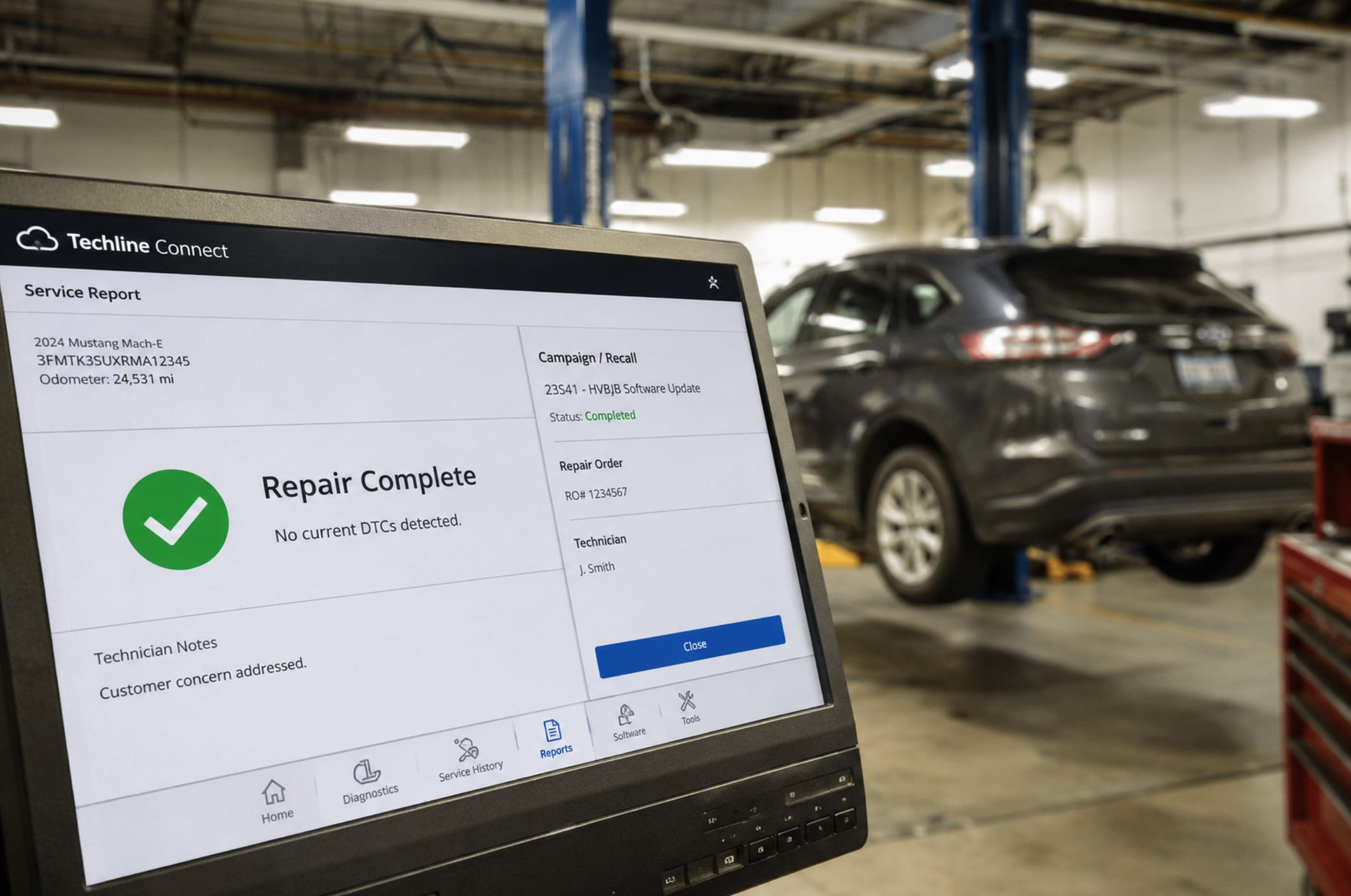
The service record says the vehicle is fixed. The vehicle is still running the wrong software. The validation file says the system passed. The field finds a sequence the lab never saw. The update cleared. The asset changed. The assurance case did not.
Automotive validation has gotten very good at answering the pre-deployment question. HIL, SIL, cloud simulation, CI/CD pipelines, shift-left testing, AI-generated test cases: all of it matters. But all of it is aimed at the same side of the lifecycle. After the update lands, the question changes.
The problem is not weak validation. The problem is stale assurance: records, assumptions, and safety cases that remain valid on paper while the vehicle keeps changing in the field.
The Part the Lab Cannot See
The limitation is obvious once you say it out loud: no one can write test cases for every condition a vehicle will encounter in the field. The combinatorial space is too large, the edge cases too unpredictable, and the interactions between software versions, hardware configurations, network conditions, and real-world environments too numerous to enumerate in any lab. One answer has been more AI in the validation loop: generative models to explore the test case space more thoroughly, anomaly detection trained on simulation data, coverage pushed further left in the development cycle. They help. They do not make the field behave like the lab.
Every certified vehicle that leaves the factory carries a set of assumptions about the conditions it will encounter. Those assumptions were valid at the point of certification. The vehicle then enters an operational environment that was not fully modeled, receives updates that alter its software stack, and is exposed to conditions that shift across its service life. The longer the vehicle is in service, the more stale the original assumptions become.
What the Recall Record Shows
General Motors recalled 4.3 million vehicles worldwide for a software defect in the airbag sensing and diagnostic module. The defect could prevent frontal airbags and seatbelt pretensioners from deploying in a crash, and it cost one person their life and injured three others. The recall record shows that a rare pre-crash dynamics sequence could activate a diagnostic routine in the SDM software and, in those specific circumstances, prevent deployment. The vehicles were certified and in service. A particular sequence in the field produced behavior the test environment did not replicate.
Ford issued a recall covering 622 U.S. Mustang Mach-E vehicles where dealer records showed a remedy as successfully installed for earlier battery contactor overheating recalls. Some of those vehicles had not received the correct software update. The record said repaired. The vehicle was not. The exposure involved a risk of the high-voltage battery contactors opening while driving, causing immediate loss of motive power. The failure was not that the update itself was malicious or technically flawed. The failure was that the evidence chain did not reliably reflect the actual vehicle state, and the divergence was not surfaced until a recall investigation found it. This is not just a dealer-process miss. It is what happens when the record becomes more trusted than the vehicle. At that point, the record is no longer evidence. It is noise.
Volkswagen recalled nearly 61,000 ID.4 and Audi Q4 e-tron vehicles for a brake control unit software error that could prevent the gearshift indicator from displaying Neutral, creating a rollaway risk if the parking brake was not engaged. That is a clean software-behavior case: released software producing unsafe behavior in a specific real-world state. A separate ID.4 recall affecting nearly 100,000 vehicles is more instructive because it is not clean. Water ingress and corrosion in door-handle electronics produced unexpected door-opening behavior at low speeds, and the remedy included both hardware replacement and software parameter updates. That is why post-deployment assurance is hard: the failure did not live neatly in hardware, software, or environment. It lived between them.
These are not identical root causes. They are variations on the same pattern, where the field produced conditions the pre-deployment process did not fully anticipate, and the divergence was not caught before a recall became necessary.
What Certification Actually Tells You
Certification tells you that a system met a defined set of requirements under a defined set of conditions at a defined point in time. Certification matters. But it is a point-in-time claim. It is not a statement about behavior under all future conditions, across all software configurations, after all subsequent updates. For automated driving systems, the intended operating envelope is commonly described as the Operational Design Domain. The ODD is validated before deployment, but the industry lacks a consistent, auditable way to monitor whether deployed systems continue operating inside that validated envelope as the vehicle ages, receives updates, experiences component degradation, and navigates conditions the lab did not model. The vehicle keeps moving. The assumptions stay frozen.
This is what I have called Assumption Decay. The assumptions embedded in the design were accurate when they were made. The field erodes them, update by update, mile by mile, season by season, without a unified signal to detect and act on the erosion. The GM airbag case shows Assumption Decay in its most serious form: a certified vehicle in service encountered a rare operational sequence that produced a safety-critical failure.
The Evidence Chain Problem
The Ford case is different in mechanism but adjacent in structure. UNECE R156, which applies to software-update management for newly produced vehicles in EU markets from July 2024, pushes OEMs toward auditable software-update governance: identifiable software versions, documented update processes, validation before rollout, and evidence that approval-relevant functions remain safe and compliant after updates. R156 helps. It still does not solve the live-state problem.
The Ford recall exposed a gap that regulation alone cannot fully close. The audit record said repaired. Some vehicles were not. This is the Systems Chain of Record problem. A chain of record is only meaningful if it continuously and accurately reflects the current state of the physical asset it documents. When the record and the vehicle diverge, the record stops being assurance. It becomes a liability. The fix is not more compliance paperwork. It is continuous reconciliation between the evidence chain and the actual vehicle state, throughout service life, not just at the moment of each update.
What the Industry Does and Does Not Watch
The automotive industry is not operating blind after deployment. OEMs and suppliers monitor field data through diagnostics, warranty claims, OTA telemetry, customer reports, cybersecurity event monitoring, recall investigations, and fleet telemetry for connected vehicles. None of this is fake. It catches real problems. The issue is that each signal watches a slice of the picture, and no layer treats the original safety assumptions as things that can expire, drift, or break across the vehicle’s service life.
The industry has post-deployment signals. It does not have a post-deployment system.
The problem is getting too large for fragments. A vehicle that receives monthly OTA updates across a dozen software modules, running perception, control, and safety functions that interact with each other and with a changing physical environment, is not well-served by warranty claims and customer complaints as the primary feedback loop.
The Trajectory That Makes This Urgent
Centralized compute, zonal controllers, and OTA-updateable stacks are turning software change into the normal state of the vehicle. Every update cycle is another opportunity for the field and the certification to drift apart. That problem exists before autonomy. Autonomy just raises the stakes. The next assurance problem is model-driven behavior. As perception, prediction, planning, and control functions become more model-driven, the gap between validated assumptions and field behavior becomes harder to manage with pre-deployment testing alone. A perception model trained on a specific sensor configuration and data distribution encounters a configuration altered by an OTA update, or a distribution shifted by a change in geography, weather, or road infrastructure. A control algorithm encounters a surface type or dynamic sequence that was underrepresented in validation. The more authority the software gets, the less acceptable that gap becomes.
The Lifecycle the Industry Has Half-Built
The industry has built real machinery before deployment: virtual prototyping, HIL, SIL, integration testing, and final validation. After deployment, it has signals: diagnostics, OTA records, warranty claims, field reports, cybersecurity monitoring, fleet telemetry, and recalls.
That is the asymmetry. Before deployment, assurance is designed. After deployment, it is inferred.
What is missing is a way to compare the vehicle in the field against the assumptions that put it on the road. That means treating the deployed asset’s actual software state as something to be continuously reconciled against the design-time safety case, generating a signal when the two diverge, before a recall is the only option left.
The validation lab has done its job. The vehicle is in service. The harder question is what governs the vehicle after the update lands.
#automotive #softwaredefinedvehicles #operationalassurance #functionalsafety #otaupdates #sdv #adas #autonomousvehicles #assumptiondecay #recallprevention #vehiclesafety #softwareupdates #odddrift #systemsofrecord

Michael Entner-Gómez is a strategist, technologist, and writer focused on the convergence of the world’s most critical infrastructure sectors: energy, transportation, and telecommunications. Using a systems-thinking approach, he helps industry incumbents and disruptors future-proof their operations, scale complex platforms, and navigate the shift to software-defined everything.
This article is not sponsored, not paid, and not written to please. It’s written to inform.